

 |
| Click here to download |
Rural broadband service providers (BSPs) face multiple challenges: competition from national companies, maintaining the personal touch that defines community-focused service, and meeting the expectations of customers who expect providers to offer the modern conveniences of the digital world.
Using multiple software systems for different departments, while once manageable for smaller operations, now creates inefficiencies that slow growth and frustrate customers. By contrast, BSPs that successfully integrate their billing, sales, and operations systems into a unified platform are discovering vast improvements in efficiency, workflow management, and customer experience (CX).
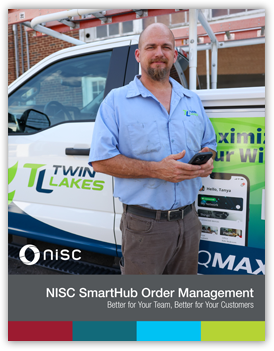
This white paper explores the risks of siloed systems and the benefits of integration. Twin Lakes, a BSP in Tennessee, leverages NISC’s SmartHub Order Management solution to help successfully integrate their systems. Twin Lakes’ experience illustrates why integrated systems are a game changer.
The costs of fragmented systems
Why is operating on multiple systems a problem? If it’s worked this long, why change? The problem is that fragmented systems aren’t really working anymore—they put BSPs at risk, make them less efficient, and worsen their CX. Fragmented systems result in poor data, inefficiencies, allocation challenges, and larger threats related to compliance issues and corporate reputation:
- Mismatched data. The most immediate challenge facing providers with disconnected systems is mismatched data. When customer information lives in separate departments, discrepancies become inevitable. When employees manually transfer information between systems, human error is almost inevitable. Engineering may see one set of customer data while customer service sees something different. This disconnect creates problems that extend far beyond mere inconvenience.
- Inefficiencies galore. Simple processes that could take minutes stretch into hours or days when they require coordination across multiple systems. For BSPs with lean teams, these inefficiencies can impact service delivery and customer satisfaction. Twin Lakes Marketing & Billing Coordinator Amanda Forgy described the efficiency gained from NISC’s integrated systems as they relate to billing: “We went from our billing process running two to three days—sometimes three to four days—down to just one day.”
- Resource allocation challenges. Without integrated systems, BSPs must allocate precious resources to managing complexity rather than serving customers. Technical staff spend time on manual data reconciliation instead of network improvements. Customer service representatives become intermediaries between systems rather than improving CX.
- Larger dangers: Compliance and reputation. Disconnected systems create compliance and audit risks. Maintaining regulatory compliance becomes harder when customer data exists in multiple versions across different platforms. Data inconsistencies can lead to billing disputes, service interruptions, and regulatory issues that can severely impact a BSP’s reputation, especially in close-knit communities where word of mouth is vital.
Efficiency through integration
There are enormous gains in efficiency when BSPs leverage an integrated system such as NISC’s SmartHub Order Management. This is due to many factors, including eliminating manual handoffs, automating workflows and communications, and increasing scalability:
- Eliminating manual handoffs. Unified systems remove the need for manual handoffs between departments. When billing, customer service, and operations share the same system, information flows seamlessly among them. Customer service representatives can access real-time billing information, engineers can see service requests as they’re generated, and billing teams can process transactions with a customer’s full information in front of them. Orders flow from initial customer requests through provisioning to billing. Payment processing connects directly to service activation and customer communication systems.
- Automating workflows and communications. Unified systems allow BSPs to set up sophisticated automation that would be impossible without integration. For example, incomplete customer leads can trigger follow-up campaigns, installations can activate billing setup and welcome communications, and payment processing can automatically update services and send confirmation messages to customers. Forgy says, “[Twin Lakes has] seen as many as 20 orders from one email when we’ve targeted customers to remind them that service is available.”
- Increasing scalability. Unified systems enable BSPs to scale their operations without proportionally increasing staff. With automated workflows managing routine transactions, employees are free to focus on more complex customer needs. This scalability is particularly valuable for providers experiencing rapid growth as fiber builds are completed. Twin Lakes General Manager and CEO Jonathan West describes the remarkable impact unified systems have on scalability: “60,000 people have been converted or signed up on fiber, and we haven’t increased our back office workforce. We’ve doubled the size of the customer base, tripled the amount of revenue, and our workforce for order processing is roughly equivalent to what it was when we started. That’s amazing.”
Serving the modern customer
Customers expect digital tools that offer convenience and automation, and CX improves when they can provide such tools. Integrated systems allow for several modern conveniences customers expect, including real-time scheduling, self-service options, and opportunities to have a single point of contact and/or a single interface:
- Real-time scheduling and resource management. Customers want to schedule in-person visits—like installations and service calls—automatically. Integrated systems enable real-time coordination between customer-facing scheduling systems and internal calendars. An integrated system can handle logistics like technician availability, inventory, and a territory’s geography. Automated scheduling eliminates the phone tag that often irritates customers.
- Self-service options through automated provisioning. SmartHub Order Management allows Twin Lakes’ customers to do things like pay bills, check their account status, and provides an opportunity for new customers to sign up for service, even after normal business hours. Forgy notes, “At least 30% of our SmartHub Order Management orders come in over the weekend or after hours.”
- Real-time information. When a customer calls a BSP with questions, representatives working with integrated systems have immediate access to the customer’s account history, transactions, and service level. Technical support staff can see billing history and service changes that might affect connectivity. Billing inquiries can be resolved with visibility into service usage and account activity. This real-time access eliminates the “Let me check on that and call you back” responses that make for an unsatisfactory customer experience.
- Single point of contact/single interface. Today’s customers expect seamless interactions regardless of how they choose to engage with their BSP. Unified systems enable providers to offer a single touchpoint for all customer needs—from initial service requests through ongoing account management and technical support. This consistency creates a CX that rivals national competitors while maintaining the personal touch for which smaller providers are known. Also, when customers use the same interface to request service, schedule installations, pay bills, and report technical issues, they develop familiarity and confidence with a BSP’s systems. This unified experience eliminates the frustration of learning multiple tools or providing the same information across different platforms.
Summary
For BSPs, the question shouldn’t be whether or not to pursue system integration, but how quickly it can be accomplished. With competition growing, providers that delay integration risk falling behind. The BSPs that embrace unified systems today will be the community champions of tomorrow, combining the local expertise customers value with the efficiency and modern conveniences they expect.